

Research project
Low-reflection – State of the art in low-glare surfaces for PV modules
Many PV modules today are labelled as ‘low-reflection’ or ‘low-glare’. Modern PV modules are also usually treated with an anti-reflective layer. Nevertheless, glare-related disturbances and problems continue to occur in solar installations. Unfortunately, these cannot be completely avoided. It is therefore important to understand the state of the art and, on this basis, to develop appropriate guidelines and limit values. It is equally important to identify situations that will certainly not lead to problems (see final report).
Key findings and insights from this project:
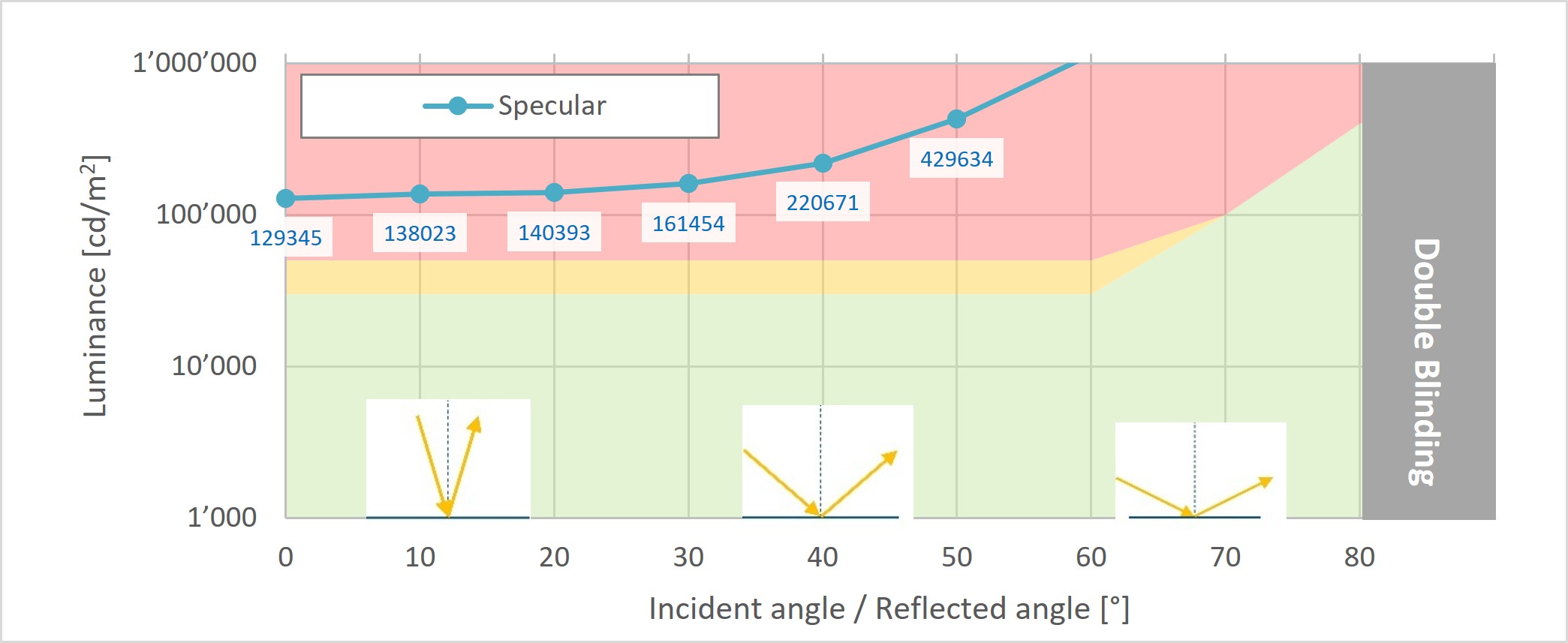
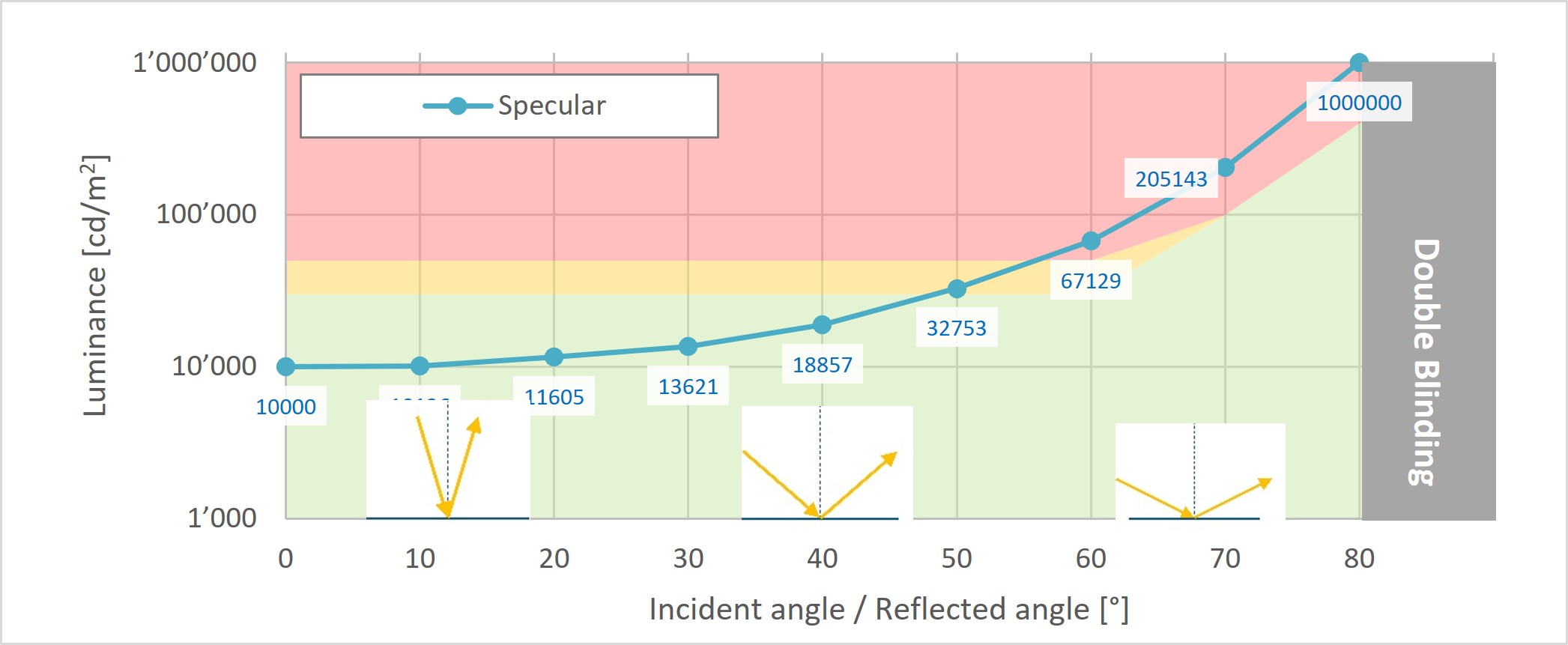
The amount of reflected light increases for almost all surfaces as the angle of incidence increases. This is not only the case for PV modules, but applies equally to windows, metal surfaces and many other materials. It therefore makes no sense to define a single upper limit for glare in cd/m² that is considered problematic. Limit values must be defined on an angle-dependent basis. One outcome of the project is therefore the proposal to define angle-dependent limits. These limit values are based on the reflectance behaviour of a normal, white-plastered wall: if a module causes less glare than a normal white wall, it can hardly be considered a nuisance. These limit values are shown in the graphs:
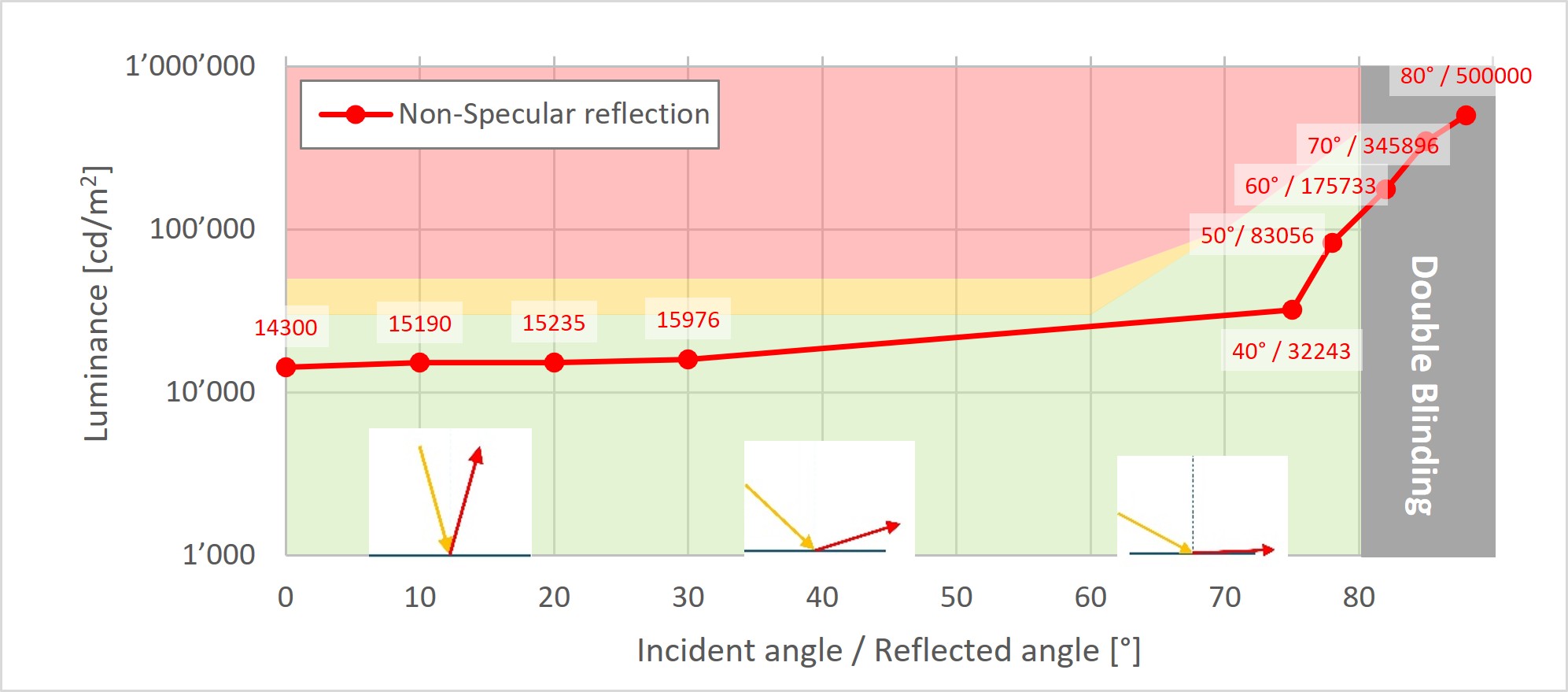
For an angle of incidence of 0°–60°, a luminance of less than 30,000 cd/m² is considered as low-glare. Values above 50,000 cd/m² are already considered as disturbing. At an angle of incidence of 70°, the boundary between low glare and dazzling is set at 100,000 cd/m².
For angles of incidence >80°, one is dazzled in any case, as one is looking almost directly into the sun, which is always unpleasant. It is therefore no longer reasonable to define threshold values.
However, it is also important to understand that glare assessment must always take into account the orientation of the roof and the surrounding environment. If the orientation is correct, even a highly blinding product can be installed without any problems. If the orientation is incorrect, even a low-glare module can be a nuisance for the neighbourhood. That is why it almost always makes sense to carry out an annual simulation (blendtool.ch)
There are now also new surfaces for which the familiar law ‘angle of incidence equals angle of reflection’ (specular reflection) no longer applies. With these surfaces, the reflection does not occur where one would expect it to be (non-specular reflection). In most cases, the light is reflected at a shallower angle than the angle of incidence once a certain angle of incidence is reached. This reflective behaviour can be strongly influenced by the surface structure. It is therefore assumed that, in future, an increasing number of surfaces with non-specular behaviour will come onto the market. In some cases, such surfaces have helped to solve glare problems. However, there is no standardised method for evaluating the glare behaviour of these new surfaces, let alone any software capable of handling it.
To better understand glare behaviour of a surface or a PV-module, it is best to measure the bidirectional reflection distribution function (BRDF). More on this at Testing – Reflection Behavior – BSDF.
Duration: 01.04.2021 - 31.10.2024
Partner:
Swissolar
Berner Fachhochschule
Basler & Hofmann
Team:
Dr. Andreas Bohren
SPF Institute for Solar Technology Deputy Director of SPF, Head of SPF Testing, Team Leader for SPF Testing & Monitoring
+41 58 257 48 25andreas.bohren@ost.ch