


Research project
The Robot Catcher
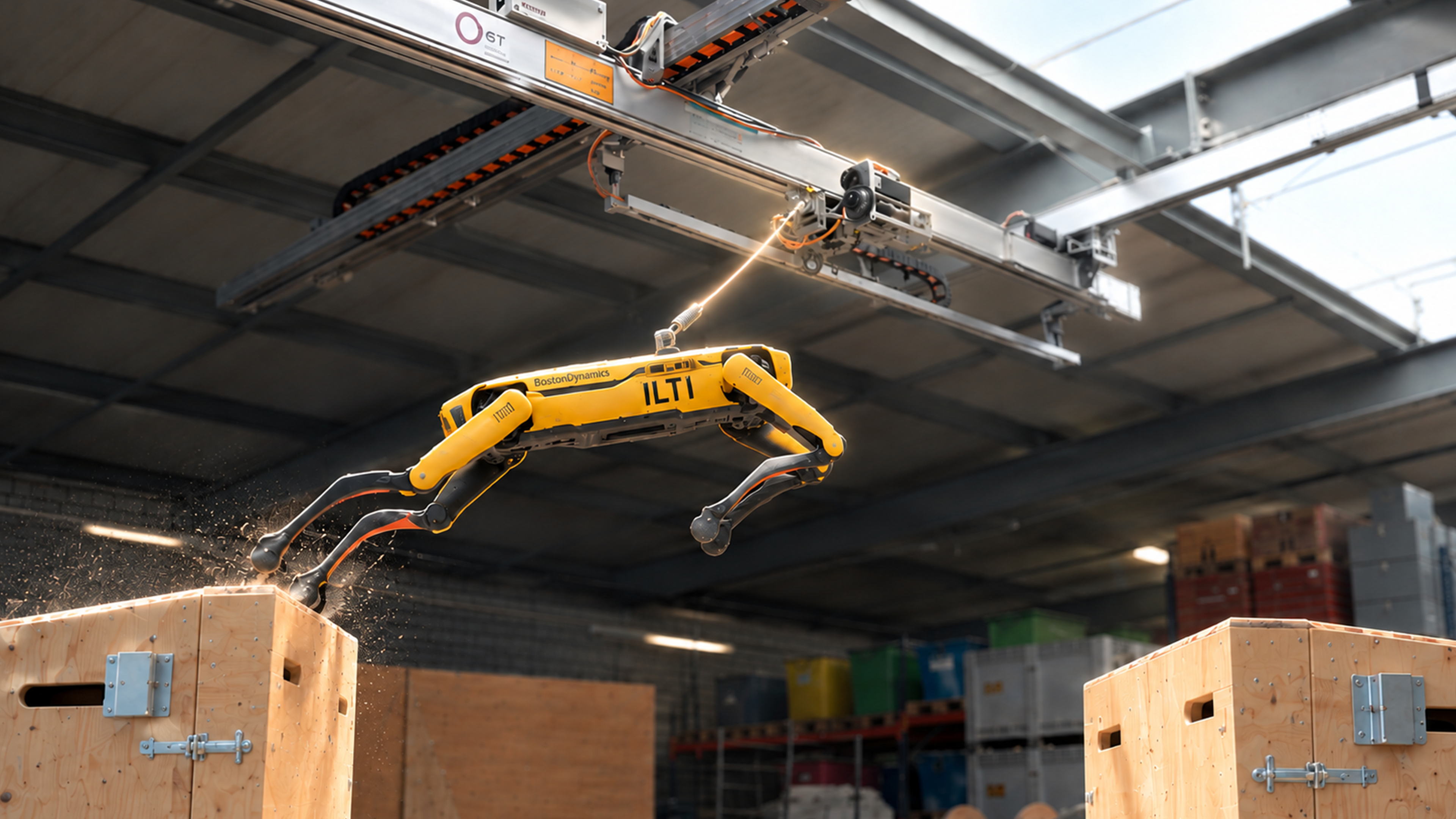
At OST – Eastern Switzerland University of Applied Sciences, we developed a mechatronic crane for testing self-balancing robots. The system catches robots when they fall, reducing the risk of damage and eliminating the need for manual fall protection. This reduces the workload for test personnel and enables partially automated testing, allowing teams to explore new movements and control strategies with fewer damage-related interruptions and cost.
How do you test a robot’s limits without every fall becoming a costly setback?
For humanoids and quadrupeds, mastering stairs, ladders, and challenging terrain requires extensive testing. Protecting the robot during these tests is essential — but the protection system must interfere as little as possible with its movement.
At ILT Interactive Robotics & Health Technology Group, we developed a mechatronic crane in collaboration with Flexion and other partners from Zurich to address this challenge. The system follows the robot automatically and catches it when it falls. Its capabilities include:
- Tracking at speeds up to 4 m/s and accelerations up to 1 G
- An upward interaction force of less than 3 N, with variations of only fractions of a newton
- Millisecond reaction times, enabling deceleration of a falling 100 kg robot at up to 4 G
This allows teams to test demanding maneuvers with less risk of equipment damage and less physical strain, while preserving the robot’s natural dynamics. Beyond fall protection, the crane supports precise lifting, smooth touchdowns, and programmable routines that return the robot to its next starting position.
Which maneuver would your team attempt if a fall carried less risk?
If you are developing legged robots, contact our team to discuss integrating the system into your testing workflow.
Partner:
Interactive Robotics & Health Technology at ILT
Prof. Dr. Yves Zimmermann
ILT Institute for Lab Automation and Mechatronics Professor | Head of Copmpetence in Interactive Robotics & Health Technology
+41 58 257 39 96yves.zimmermann@ost.ch
