

Research project
SNF-Vortex: Novel experimental methods for investigating wind turbine rotor blade tip vortex formation and breakdown in atmospheric turbulence
Wind energy is a key technology for reaching ambitious international net-zero goals, and for the accurate planning and operation of wind energy projects, it is essential to model the atmospheric flow and its interaction with individual wind turbines and entire wind farms. One of the key aspects of understanding the physics of atmospheric flows and their interactions with wind turbines and wind farms as a whole is the formation and breakdown of tip vortices.
Despite the fact that recent research has revealed the importance of the scales in the inflow turbulence on wind turbine and wind farm power output, and far wake development, the effects of atmospheric turbulent conditions on (1) the aerodynamic forces acting near the rotor blade tip and the resulting tip vortex formation, (2) the subsequent tip vortex breakdown in the near wake and (3) the interactions and coupling effects between the tip vortex formation and its breakdown are not well understood. In order to do this, there is a need for field experiments which overcome the limitations of computational and laboratory based studies.
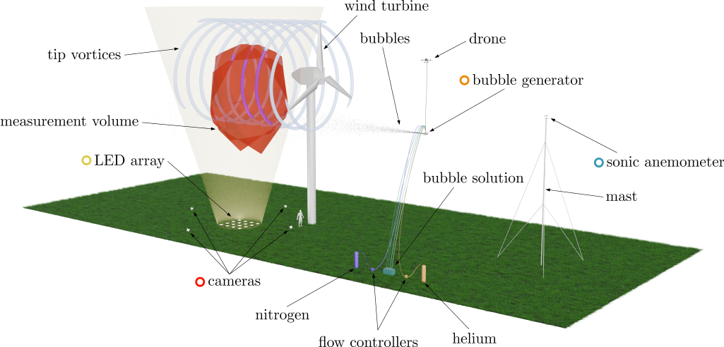
The overarching aim of this proposal is therefore to develop novel field experimental methods for studying combined effects of atmospheric turbulence on tip vortex formation and breakdown in the near wake of an operating wind turbine in the field. We do this by addressing the following objectives: (1) Develop a novel experimental method for studying the effect of atmospheric turbulence on blade aerodynamics near the tip; (2) Develop a novel experimental method for studying the effect of atmospheric turbulence on tip vortex dynamics in the near wake; (3) Use the resulting data to determine relationships between inflow conditions, blade aerodynamics and vortex dynamics and (4) Publish unique open data sets to enable further research into the effects of atmospheric turbulence on blade tip aerodynamics and tip vortex dynamics. The work involves adapting and scaling up existing experimental techniques from the two applicants, the Aerosense rotor blade surface measurement system from OST and the wind tunnel scale 3D Lagrangian particle tracking system from MPI-DS, in order to gain new scientific insights in the field. A strong focus of this project is to leverage the insights from the flow visualisation method to relate blade aerodynamics to vortex dynamics.
The unique combination of blade surface pressure measurements and 3D time-resolved flow visualisations implemented in this project will deliver key insights into novel experimental techniques within and beyond the wind energy sector. The published data sets of simultaneous blade pressure distribution and flow visualisation information at high Reynolds numbers in operating conditions can be used for the future validation of models and numerical simulations. Our improved scientific understanding of the effect of turbulence length scales on tip vortex formation and breakdown will advance wind energy science in the key area of atmospheric flow through wind farms. We will also develop improved physics-based tip correction and near wake length models, which will take into accound atmospheric conditions and be less depend on tuning parameters, and can be directly implemented by wind turbine designers and wind farm planners.Finally, as part of this project, three young postdoctoral/senior researchers and one doctoral researcher, as well as the main applicants, will receive a unique opportunity to learn about the fascinating field of tip vortex aerodynamics, which will allow them to in turn continue their research careers in the future in connected fields.
Duration: 01.09.2026 - 30.09.2029
Funding:
SNF (Schweizer Nationalfond)
Team:
Dr. Sarah Barber
IET Institute for Energy Technology Head of Wind Energy Innovation Division
+41 58 257 42 62sarah.barber@ost.ch