


10.09.2026 SWISS AUTOMATION in Rapperswil

Speaker profiles
Keynote: Dr. Alessandro Curioni, IBM Fellow, Vice President Europe & Africa, IBM Research and Director, IBM Research Europe - Zurich
Keynote: Redefining Automation: The AI-Quantum Synergy

Dr. Alessandro Curioni
IBM Fellow, Vice President Europe & Africa, IBM Research and Director, IBM Research Europe - Zurich
Dr. Alessandro Curioni is an IBM Fellow, Vice President of IBM Research Europe and Africa and Director of the IBM Research Lab in Zurich, Switzerland. He is responsible for IBM corporate research in Europe and leads IBM's global research strategies in Accelerated Discovery and Security.
Dr. Curioni is an internationally recognized leader in the area of high-performance computing and computational science, where his innovative thinking and seminal contributions have helped solve some of the most complex scientific and technological problems in healthcare, aerospace, consumer goods and electronics. He was a member of the winning team recognized with the prestigious Gordon Bell Prize in 2013 and 2015. Currently, his research interests include accelerating the rate of discovery with AI, Quantum, and Hybrid Cloud. Dr. Curioni received his undergraduate degree and PhD in Theoretical Chemistry from Scuola Normale Superiore, Pisa, Italy. He started at IBM Research – Zurich as a PhD student in 1993 before officially joining as a research staff member in 1998. Since then, he has had several research and manager roles, including as the founding manager of the Cognitive Computing and Computational Sciences department. He is a member of the Swiss Academy of Technical Sciences
Abstract
Redefining Automation: The AI-Quantum Synergy
Groundbreaking technology has always been a catalyst for progress in industry, science and business. As we enter a revolutionary era – one defined by the convergence of AI and quantum computing – we are beginning to tackle challenges once deemed too complex, forging solutions that were previously beyond reach.
Automation itself is being reshaped by the synergistic use of AI and quantum technologies, enabling systems to learn intricate patterns, reason with greater precision, and act at unprecedented speeds. In this keynote, I will explore the principles of AI and quantum computing and demonstrate how the combined power of these technologies is already revolutionizing automation and driving groundbreaking advances for the benefit of society.
Symposium on Lab Automation | Health and Life Science
The evolution of lab automation: From pipets to cloud labs

Oliver Peter
Oliver is co-founder and president of the Standardization in Laboratory Automation (SiLA) consortium and presently a freelance consultant on drug discovery, R&D digitalization and automation, sample logistics and biobanking.
He started his career in small molecule drug discovery 2002 with Axovan AG, then Actelion and Idorsia Pharmaceuticals. From 2008, he built, lead and developed their state-of-the-art automated HTS and compound management facility and the research biobank for translational science. 2023-2024 he was consultant and then Director, Research Digitalization with Molecular Partners AG.
2021 Oliver initiated a project (ultimately not funded by the SNF in 2023) to establish a fully automated, closed-loop design-make-test platform for peptide development as an academia-pharma partnership lead by the University of Basel.
Oliver holds a PhD in Molecular Developmental Biology from the University of Zurich.
Abstract
The evolution of lab automation: From pipets to cloud labs
(With a Swiss perspective)
Looking back 20 years, lab automation has evolved significantly and at accelerating pace. Driven initially by the scientist's need to perform traditional laboratory work more efficiently and at higher throughput, lab automation has emerged as a field in its own right that increasingly shapes experimental design. Today we need both reliable automation modules with restricted feature set (such as for QC), and fully flexible, dynamically controlled and non-deterministic systems (for R&D) that may build on them.
I will outline the power of evolution as a universal principle in the development and optimization of industrial products and processes, and describe how to design automated labs to enable them. I will provide an overview of global efforts to build such «self-driving labs» that are fueled by the unprecedented developments in machine learning and generative AI.
Looking forward, I will consider the possibly transformational consequences of cloud labs to the
experimental sciences. Who will build the «Experimental Processing Units» to work with the CPUs andGPUs? Who will develop their operating system, and who will run the experimental server farms?
Instrument connectivity in the age of AI: A journey from device to SDL


Dr. Lukas Bromig, CO-CEO & Founder, UniteLabs GmbH
Dr. Lukas Bromig is Co-CEO and founder of UniteLabs GmbH, a company he established following his PhD research at the Technical University of Munich on the digitalization and automation of industrial biotechnology. His doctoral work focused on accelerating bioprocess development through automation, parallelization, miniaturization, and digitalization, culminating in the first prototype of what is now the UniteLabs Platform, an AI-ready infrastructure for laboratory automation.
At UniteLabs, he oversees product vision and strategy while leading customer success, implementation, and technical sales teams. His academic background is reflected in numerous peer-reviewed publications on bioprocess automation, modeling, and control. Lukas’ work bridges cutting-edge research with applied innovation, enabling faster and more reliable laboratory operations in the pharmaceutical and life sciences industries.
Abstract
Instrument connectivity in the age of AI: A journey from device to SDL
The speed at which data needs to be produced is accelerating tremendously, yet laboratory infrastructure and modes of operation are not keeping pace. Substantial investment is flowing into data factories and AI for applications such as drug discovery, and the push toward more and better data—to train models and tighten validation loops—is raising the bar for lab automation and reshaping the requirements placed on lab equipment. This presentation examines why, despite this pressure, the self-driving lab (SDL) remains out of reach for most laboratories, and what an architecture that closes the gap might look like—conceived as an operating system for the lab.
The journey begins with device connectivity, where introspectable, standardized interfaces—such as those emerging from SiLA 2 and OPC UA LADS—form the bare minimum for any AI-ready lab. On top of this foundation sits a common language for the lab: a digital representation of every entity, from devices and labware to reagents and workflows, grounded in a shared ontology and accessible in real time down to well-level granularity. This layer is what makes a workflow description language possible—the surface area through which AI agents can act, turning physical AI into reality. The talk closes with use cases spanning closed-loop experimentation, full SDLs, and AI-driven automation, offering a glimpse into the future of lab automation.
Distributed Intelligence Self-Driving Laboratory: Let the Machine Talk

MER Pascal Mieville, PhD, MPA, EPFL Swiss Cat+ West Hub
Operational director Swiss Cat+ West Hub EPFL
Vice-President Centre de Compétences en Chimie et Toxicologie Analytiques CCCTA
Membre comité Association Francophone de Chimie Accélérée et Digitalisée AFCAD
Membre du collège des experts chimie HEIA-FR
Pascal Miéville studied chemistry at the University of Geneva and EPFL, earning a Master’s degree in physical chemistry and a PhD in hyperpolarized NMR (DNP-NMR) under Professor Geoffrey Bodenhausen. At EPFL, he led the development and management of the NMR platform, while also teaching NMR at the master’s and doctoral levels. Since 2020, he serves as Maître d’Enseignement et de Recherche and Executive Director of the Swiss Cat+ West Hub at EPFL, leading the development of the research infrastructure and service. In this context, he develops, in collaboration with industry and international academic partners, education and research programs in self-driving laboratories and data-driven chemistry. He also act as consultant for lab automation projects in industry.
Abstract
Distributed Intelligence Self-Driving Laboratory: Let the Machine Talk
The recent emergence of generative AI and in-silico chemistry has accelerated the development of self-driving
laboratories and autonomous experimentation. However, in chemistry, and more broadly in experimental
sciences, the “devil hides in the details.” Real experiments require countless fine tunings, adaptive corrections, and
contextual decisions that remain extremely difficult to predict, even with the most powerful high-level generative
algorithms.
In this presentation, we propose a distributed intelligence architecture for self-driving laboratories in which highlevel
cognitive systems, including generative AI, predictive models, and in-silico chemistry tools, are coupled to a
lower adaptive intelligence layer responsible for translating strategic objectives into robust experimental operations.
Inspired by the functional organization of the human body, this distributed layer continuously interprets signals and
descriptors extracted directly from laboratory equipment in order to autonomously adapt procedures, correct
deviations, and guide subsequent decisions in real time.
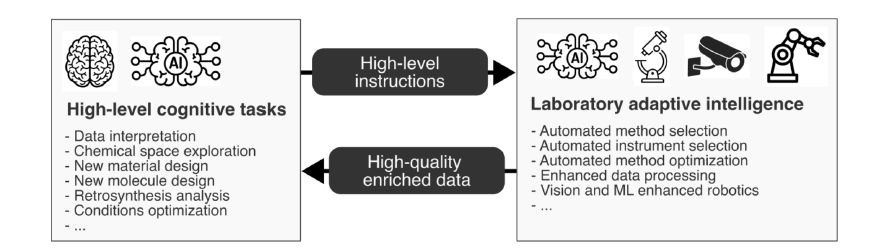
We will present the conceptual foundations of this architecture and illustrate its implementation through several
concrete examples developed at the Swiss Cat+ West Hub at EPFL. Finally, we will discuss future development axes
and perspectives for distributed intelligence in autonomous laboratories and data-driven chemistry.
• Jean-Charles Cousty, Pascal Miéville, Human Body as a Model for Distributed Intelligence in Self-Driving
Laboratories, submitted (2026)
• P. Laveille, P. Miéville, et al., Swiss CAT+, a Data-driven Infrastructure for Accelerated Catalysts Discovery
and Optimization. CHIMIA 77, 154–154 (2023)
• J.-C. Cousty, T. Cavagna, A. Schmidt, E. Mariano, K. Villat, F. de Nanteuil, P. Miéville, GLAS: an open-source
easily expandable Git-based scheduling architecture for integral lab automation. Digit. Discov. 3, 2434–
2447(2024)
• J. Li, C. Ding, D. Liu, L. Chen, J. Jiang, Autonomous laboratories in China: an embodied intelligence-driven
platform to accelerate chemical discovery. Digit. Discov., doi: 10.1039/D5DD00072F (2025)
Physical AI: From Intelligent Software to Autonomous Machine-to-Machine Collaboration

Bernd Gleixner
Divison President Automation, Managing Director Chemspeed
Vice President Operations
BioSpin Group
Abstract
Physical AI: From Intelligent Software to Autonomous Machine-to-Machine Collaboration
Artificial Intelligence is rapidly expanding the capabilities of machines to understand, reason and make decisions. The next frontier is Physical AI—the seamless integration of AI, robotics and instruments into autonomous systems that can act in the real world.
Through examples from self-driving laboratories, autonomous experimentation and lab automation, this presentation explores how intelligent software becomes physical action through machine-to-machine collaboration. It highlights both the opportunities and the challenges of connecting AI with physical systems, including the importance of interfaces, validation, data management, safety and human oversight.
The future of lab automation will not be defined by how humans interact with machines, but by how intelligently machines interact with each other.
Symposium on Robotics and Industrial Automation
Why optics on demand will define the next generation of industrial vision systems

Daniele Ghedalia, Sales Manager (B2B) | Optics & Photonics | Driving Growth in Machine Vision, Medical & Semiconductor, Optotune Switzerland AG
Startup Pitches


Eris Dhionis Sako, Co-founder & CEO, Duatic AG
Eris Dhionis Sako, a robotics engineer and ETH Zurich alumnus, is the co-founder and CEO of Duatic AG. The startup is a pioneer in humanoid wheeled robots for industrial automation, developing advanced systems like the DXTR platform and DynaArm. Duatic AG enables industrial and logistics applications to achieve dynamic adaptability and high process efficiency where traditional approaches relying purely on rigid, single-purpose automation fail. By combining proprietary Quasi-Direct Drive actuators, robust control systems, and agile mobile manipulation, Duatic AG enables a shift from heavy, resource-intensive, and inflexible machinery to fast, highly cost-efficient, and versatile production solutions. Target applications include flexible manufacturing and logistics, and mining infrastructure maintenance.


Barbara Horvath is the co-founder and CEO of Inveel AG, a Swiss deep-tech startup developing ultra-thin sensor skins for robots. Her work focuses on enabling robots to perceive their environment through touch, proximity, and temperature sensing. Barbara holds a PhD in materials science from NIMS (Japan) and has conducted research and engineering work across leading institutions in Japan, France, and Switzerland. After several years in industry as an R&D engineer and project manager, she founded Inveel to bring advanced sensing technologies from lab to real-world robotic applications.
Inveel AG is a Swiss deep-tech startup developing ultra-thin, flexible sensor skins that enable robots and automated systems to perceive their environment through proximity, touch, pressure, and temperature sensing. Designed for industrial automation, Inveel’s technology enhances safe human-robot collaboration, improves object handling, and enables more adaptive and intelligent automation processes. By bringing human-like sensing capabilities to machines, Inveel unlocks the automation of previously unautomatable processes. The company is working with partners to integrate next-generation sensing into industrial automation and advanced manufacturing systems.


Dr. Manuel Biedermann is the co-founder and CEO of nureo AG, an ETH Zurich startup developing an AI-powered software engine to automate manual CAD design and engineering tasks. nureo helps engineers accelerate product development by automating repetitive design work, enabling faster design iterations, reducing engineering effort, and improving overall productivity. Potential applications include components for laboratory equipment, fluid handling systems, nozzles, mixers, robotic parts, fixtures, and other engineering-intensive components that benefit from faster development, flexible design adaptions, and customization.


Lucien Segessemann, TEM BeamPilot GmbH
Lucien Segessemann, a mechanical engineer and ETH Zurich alumnus, is the co-founder of TEM BeamPilot GmbH. As a Swiss spin-off from TEM Messtechnik, the startup develops accurate laser beam pointing technology to stabilize dynamic optical paths. TEM BeamPilot enables laser applications to achieve micrometer accuracy and process control for continuous and pulsed laser systems where traditional approaches relying purely on passive stability fail. By combining advanced control algorithms, precise measurement schemes, and rapid actuators, TEM BeamPilot enables a shift from heavy, expensive machinery to fast, highly cost-efficient production solutions. Target applications include high-precision and large-area laser machining, laser microscopy an optics R&D.


Samuel Gasser & Hannes Scherrer
Planaro is developing a novel automation system for modern production environments. Today’s systems are increasingly reaching their limits due to rigid line based structures, especially when facing high product diversification and fluctuating demand. Planaro addresses this challenge by transforming material flow from the traditional production line into a freely usable production plane. Multidirectional shuttles move workpiece carriers between process stations, enabling robust workflows down to batch size 1. This allows manufacturers to handle greater product variety, reduce the risk of full line stoppages and scale capacity step by step with market demand. Originating as a student project at the Eastern Switzerland University of Applied Sciences, Planaro combines current research with concrete industrial application potential. At the Startup Pitch at Swiss Automation, we will present how moving from the line to the plane can shape the next generation of production systems.
From Vision Algorithms to Industrial Advantage: A Paradigm Shift Trough Automated Inspection of Consumables

David Meier, Leader Technology Industrial Automation & Team Leader, MSc ETH Mechanical Engineer, Gritec AG
From years of travel to innovative work in a hiking paradise:
After spending time in Indonesia, Singapore, and Switzerland, David Meier studied Mechanical Engineering at ETH Zurich. He gained his first practical experience during an industrial internship at Bosch. Since 2013, he has been working at Gritec, where he specializes in automation projects, simulations, and innovative solutions in automation. Today, he leads a team in the automation department, focusing on the successful implementation of complex projects in which innovation is translated into practical customer success.
Abstract
From Vision Algorithms to Industrial Advantage: A Paradigm Shift Trough Automated Inspection of Consumables
For decades, the quality of consumables has been assured through statistical sampling. Full inspection was simply not feasible. It was too slow, too expensive, and difficult to validate in a production environment.
This presentation shows how automation, machine vision, process monitoring and traceability can be combined into an integrated 100% inspection strategy and explores the benefits beyond quality assurance, and therefore challenging the above stated paradigm.
The future of automation will not be defined by how many parts can be produced, but by how reliably the quality of every individual part can be verified. As a result, 100% control is evolving from a quality tool into a key competitive advantage.
Bringing Physical AI in the factory floor with the sense of touch

Klajd Lika, CEO and Founder, Bota Systems AG
Klajd Lika is a robotics entrepreneur and mechanical engineer specializing in force and torque sensing for robotic applications. With over 14 years of experience in robotic sensing technologies, he focuses on developing advanced sensor systems that enable robots to interact with their environment with greater precision and safety. He is the CEO and co-founder of Bota Systems. Klajd has spearheaded the technology and business development of Bota Systems acknowledged and trusted by the biggest technology companies.
Abstract
Bringing Physical AI in the factory floor with the sense of touch
In this talk , you will discover the role of reliable hardware in building Physical AI models and how they can be used on the factory floor. In the recent years the breakthroughs in AI have had a significant impact on how people envision robot programming. A big ecosystem has emerged with AI at its core. All data collection methods, foundation models and AI architectures, used to build Physical AI, are all “Data hungry” systems. High-quality and capable robotic systems, with reliable and accurate tactile and force/torque sensing has shown that lead to higher success rates, generalizability and intuitiveness in robotic learning.

